Diamonds
The World's Most Famous Diamonds
By Marc H. Merritt, GIA Diamond Program Graduate · March 2, 2024
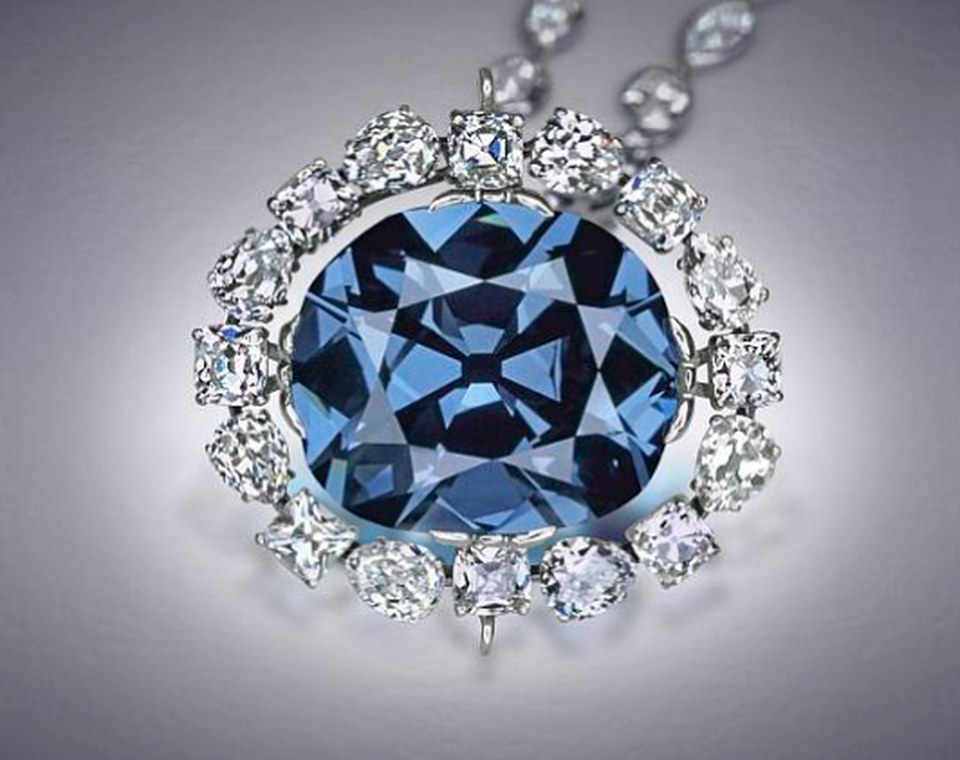
Discover the tales of the world's most famous diamonds, their origins, the hands they've passed through, their estimated worth in today's market, and where they reside now. These stones are symbols of wealth and power and have fascinating histories that have shaped them.
1. The Hope Diamond
- Specifics: 45.52 carats, deep blue.
- Origin: India, likely from the Kollur Mine.
- Prominence: Famous for its size, color and the superstition of a curse that brings misfortune to its owner.
- Found: The date of discovery is unknown, but it appeared in the gem market of India in the 17th century.
- Estimated worth: Values fluctuate; historical estimates have put it at over $200 million.
- Current location: Smithsonian National Museum of Natural History, Washington, D.C.
The diamond was acquired by Henry Philip Hope in the early 19th century, from whom it gets its current name. After changing hands through various owners, including the American socialite Evalyn Walsh McLean, who was known for wearing it regularly, the Hope Diamond was eventually sold to the renowned jeweler Harry Winston in 1949. Winston donated it to the Smithsonian Institution in Washington, D.C., in 1958, where it has become a significant attraction, drawing millions of visitors each year.
Throughout its history, the Hope Diamond has been surrounded by legends of a curse, with some owners reportedly suffering misfortune and tragedy. However, these tales have only added to the diamond's mystique and allure. Today, the Hope Diamond is admired not only for its exceptional beauty and rare color but also for its rich and tumultuous history.
2. The Cullinan Diamond
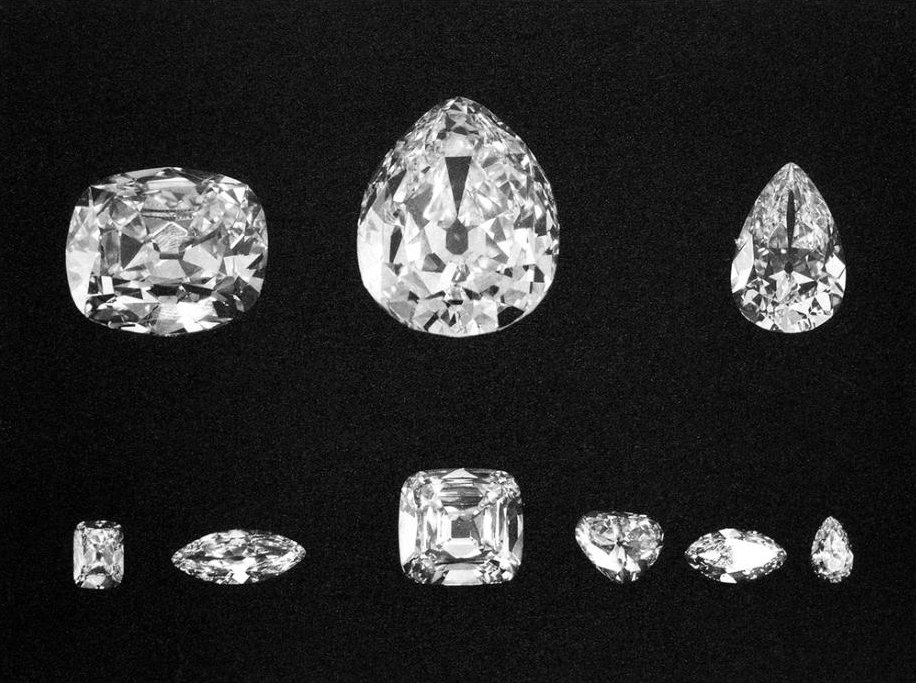
- Specifics: Originally 3,106 carats, uncut.
- Origin: South Africa.
- Prominence: The largest rough gem-quality diamond ever found.
- Found: 1905 in the Premier Mine.
- Estimated worth: The largest stones cut from the Cullinan, such as the Cullinan I or Great Star of Africa, are priceless and insured for over $400 million.
- Current location: The largest cuts are in the British Crown Jewels in the Tower of London.
The Cullinan produced nine major stones totaling 1,055.89 carats:
- Cullinan I, or the Great Star of Africa, is a pendeloque-cut brilliant weighing 530.2 carats, with 74 facets.
- Cullinan II, or the Second Star of Africa, is a cushion-cut brilliant with 66 facets weighing 317.4 carats, set in the front of the Imperial State Crown.
- Cullinan III, or the Lesser Star of Africa, is pear-cut and weighs 94.4 carats. In 1911, Queen Mary, wife and consort of George V, had it set in the top cross pattée of a crown she bought for her coronation.
- Cullinan IV, also referred to as a Lesser Star of Africa, is square-cut and weighs 63.6 carats. It was also set in the base of Queen Mary's Crown but was removed in 1914.
- Cullinan V is an 18.8-carat heart-shaped diamond set in the center of a platinum brooch that formed part of the stomacher made for Queen Mary to wear at the Delhi Durbar in 1911.
- Cullinan VI is marquise-cut and weighs 11.5 carats. It hangs from the brooch containing Cullinan VIII and forms part of the stomacher of the Delhi Durbar parure.
- Cullinan VII is also marquise-cut and weighs 8.8 carats. It was originally given by Edward VII to his wife and consort, Queen Alexandra. After his death, she gave the jewel to Queen Mary, who wore it as a pendant hanging from the diamond-and-emerald Delhi Durbar necklace, part of the parure.
- Cullinan VIII is an oblong-cut diamond weighing 6.8 carats. It is set in the center of a brooch forming part of the stomacher of the Delhi Durbar parure. Together with Cullinan VI it forms a brooch.
- Cullinan IX is the smallest of the principal diamonds cut from the Cullinan rough. It is a pendeloque, or stepped pear-cut, stone weighing 4.39 carats, set in a platinum ring known as the Cullinan IX Ring.
3. The Koh-i-Noor
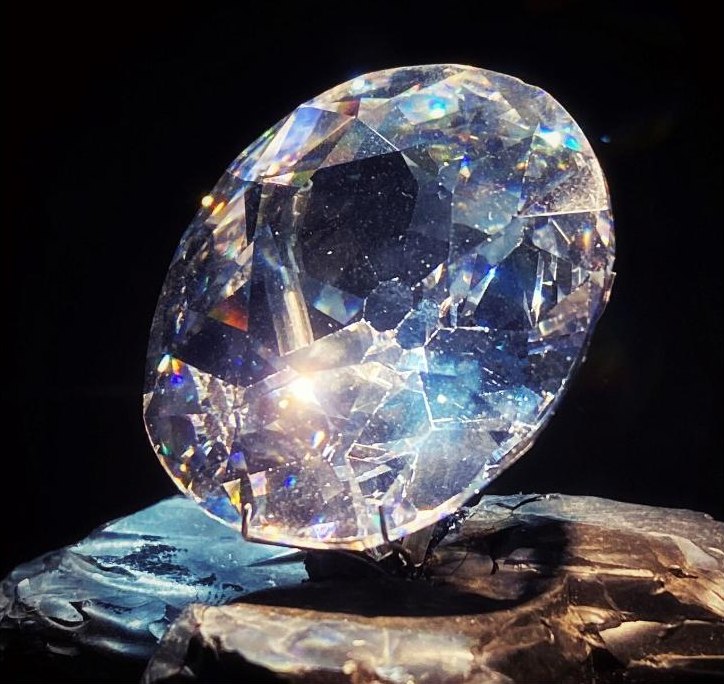
- Specifics: 105.6 carats, oval cut.
- Origin: India.
- Prominence: Known for its long history and a supposed curse that allows it to be worn only by women.
- Found: Its history dates back to the early 14th century, though its origin is unknown.
- Estimated worth: As of November 2023, the Koh-i-Noor was valued at $591 million, though some say its true value is unknown and that it is priceless.
- Current location: Part of the British Crown Jewels, Tower of London.
The Koh-i-Noor (Persian for "Mountain of Light"), also spelled Koh-e-Noor, Kohinoor and Koh-i-Nur, is one of the largest cut diamonds in the world, weighing 105.6 carats. It is part of the Crown Jewels of the United Kingdom and is currently set in the Crown of Queen Elizabeth The Queen Mother.
4. The Pink Star
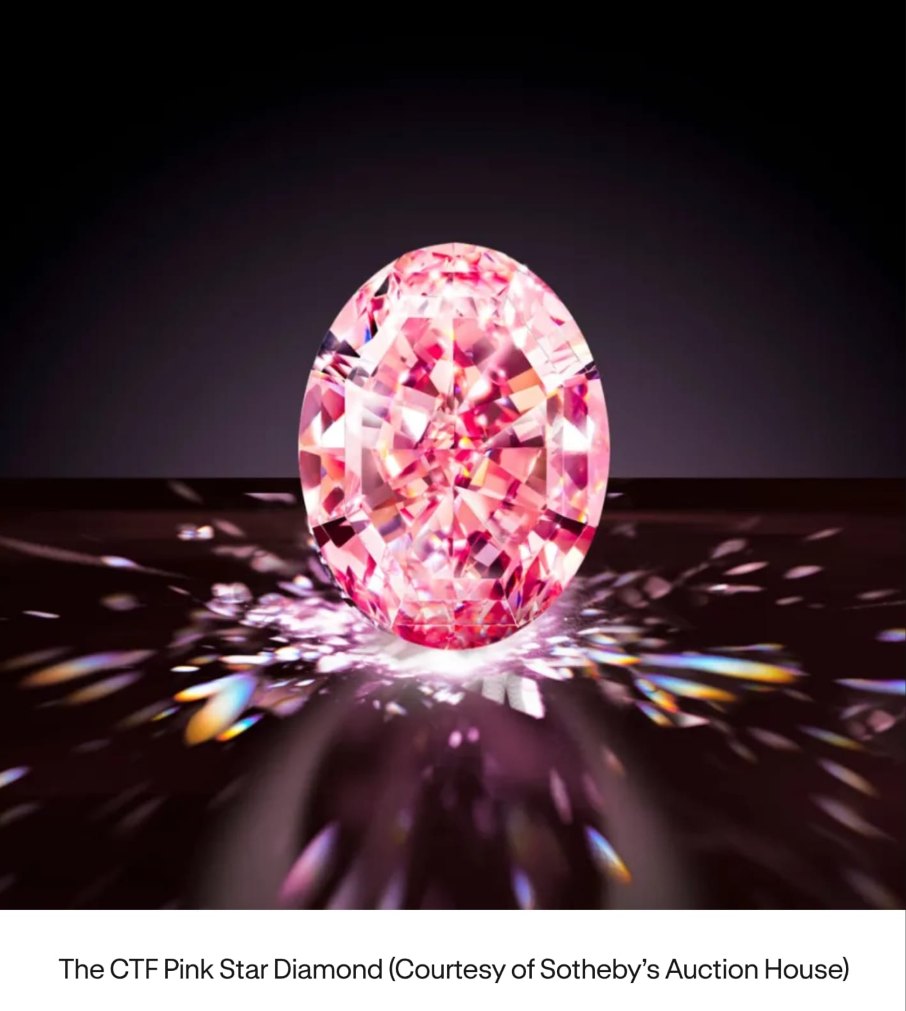
- Specifics: 59.60 carats, Fancy Vivid Pink.
- Origin: South Africa.
- Prominence: The most expensive diamond ever sold at auction.
- Found: Mined by De Beers in 1999.
- Estimated worth: Sold for $71.2 million in 2017.
- Current location: Acquired by Chow Tai Fook Enterprises, Hong Kong.
The stone is the largest Flawless Fancy Vivid Pink diamond ever graded by the Gemological Institute of America, weighing 59.6 carats. Its sale eclipsed the $57.5 million achieved in May 2016 by the 14.62-carat Oppenheimer Blue at Christie's Geneva.
The Pink Star was mined by De Beers in South Africa in 1999 and weighed 132.5 carats in the rough. Because of its exceptional rarity, Steinmetz Diamonds took a cautious 20 months to cut it. It was unveiled in Monaco on May 29, 2003, in a public ceremony.
5. The Centenary Diamond
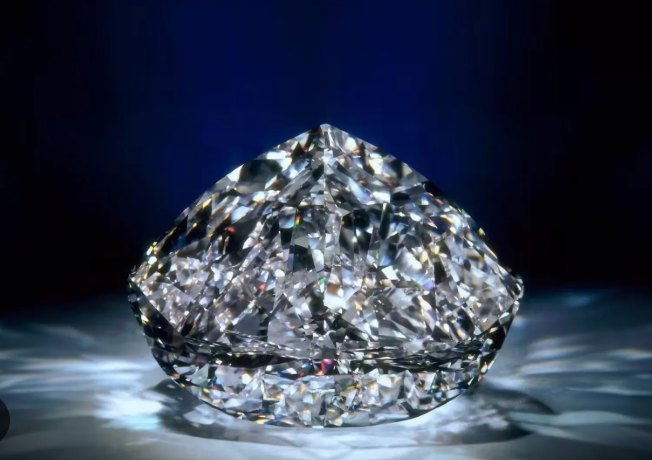
- Specifics: 273.85 carats, D color (colorless).
- Origin: South Africa.
- Prominence: Known for its flawless clarity and color.
- Found: Discovered in 1986 at the Premier Mine.
- Estimated worth: Estimated to be worth over $100 million.
- Current location: Last known to be owned by De Beers Group.
The De Beers Centenary Diamond is, at 273.85 carats, the third-largest diamond produced by the Premier Mine. Among top-color diamonds, only the Cullinan I and II are larger.
The Centenary Diamond was discovered at the Premier Mine on July 17, 1986, using the mine's X-ray imaging system. The original rough weighed 599 carats and was presented on May 11, 1988, at the centennial celebration of De Beers Consolidated Mines. As then-chairman Julian Ogilvie Thompson said, "We have recovered at the Premier Mine a diamond of 599 carats which is perfect in color—indeed, it is one of the largest top-color diamonds ever found." Naturally, it was called the Centenary Diamond. Its clarity is flawless, which is very rare: only a couple of diamonds of this purity are found each year, let alone at this size.
6. The Regent Diamond
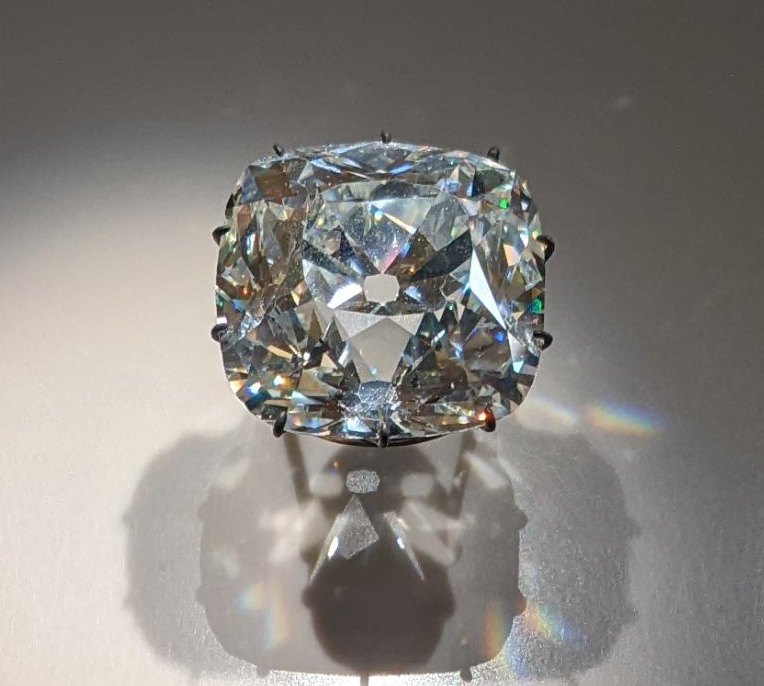
- Specifics: 140.64 carats, cushion cut.
- Origin: India.
- Prominence: Once considered the most beautiful diamond in the world.
- Found: Discovered in 1698 in the Kollur Mine.
- Estimated worth: Valued at over $60 million.
- Current location: On display at the Louvre Museum, Paris.
The Regent Diamond is a 140.64-carat diamond owned by the French state and on display at the Louvre in Paris. It is one of the world's most famous diamonds for its size, weight, purity and transparency.
According to legend, the diamond was discovered by an enslaved man in the Kollur Mine near the Krishna River, who concealed it in a leg wound while fleeing the siege of Golconda. He made it to the Indian coast, where he met an English sea captain who offered him half the profits from selling the diamond in exchange for safe passage out of India. Instead, the captain killed him and sold the diamond to the eminent Indian diamond merchant Jamchand.
Portions of the diamond histories in this article are adapted from Wikipedia, used under the CC BY-SA 4.0 license.
The ten most expensive diamonds in the world
For a wider view, here is how the stones above stack up against the rest of the world's most valuable diamonds, ranked by estimated value.
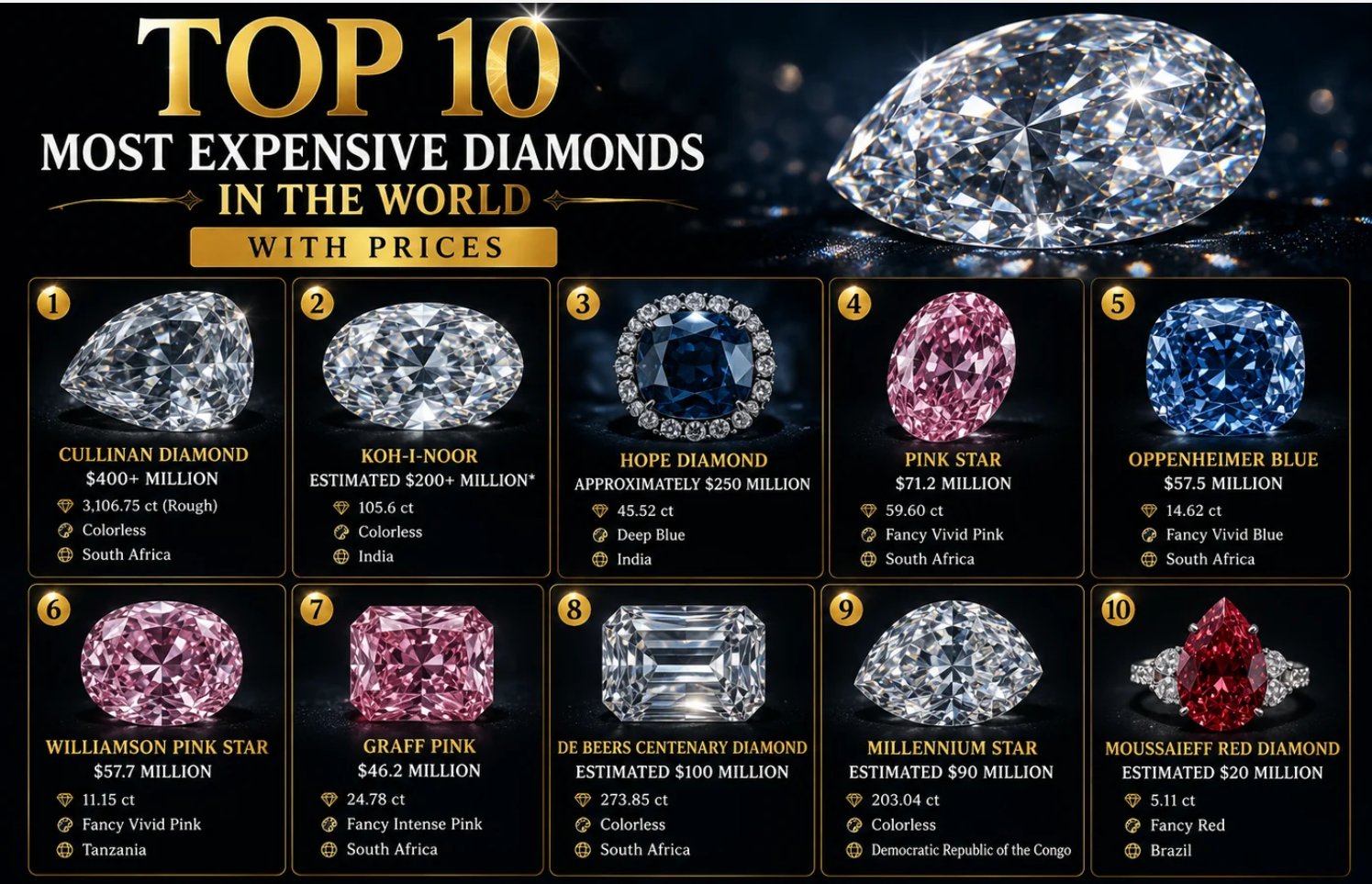
| # | Diamond | Estimated value | Weight | Color | Origin |
|---|---|---|---|---|---|
| 1 | Cullinan Diamond | $400+ million | 3,106.75 ct (rough) | Colorless | South Africa |
| 2 | Koh-i-Noor | Est. $200+ million | 105.6 ct | Colorless | India |
| 3 | Hope Diamond | Approx. $250 million | 45.52 ct | Deep blue | India |
| 4 | Pink Star | $71.2 million | 59.60 ct | Fancy vivid pink | South Africa |
| 5 | Oppenheimer Blue | $57.5 million | 14.62 ct | Fancy vivid blue | South Africa |
| 6 | Williamson Pink Star | $57.7 million | 11.15 ct | Fancy vivid pink | Tanzania |
| 7 | Graff Pink | $46.2 million | 24.78 ct | Fancy intense pink | South Africa |
| 8 | De Beers Centenary Diamond | Est. $100 million | 273.85 ct | Colorless | South Africa |
| 9 | Millennium Star | Est. $90 million | 203.04 ct | Colorless | Democratic Republic of the Congo |
| 10 | Moussaieff Red Diamond | Est. $20 million | 5.11 ct | Fancy red | Brazil |
Source: Black Diamond, "Top 10 Most Expensive Diamonds in the World with Prices," July 9, 2026. Values are estimates and change with the market.