Mineral specimens
Before a gemstone is ever cut, it grows as a crystal in the earth. These are some of the finest natural specimens I have seen at mineral and gem shows, plus a corner of my own collection. They are shared here simply to enjoy. None of them are for sale.
Seen at shows and galleries
Presentation specimens I captured at shows and galleries I visited. Each belongs to its owner; I share them for their beauty and for what they teach about how gems form.
Rhodochrosite
A dense cluster of sharp, glassy crystals in an intense raspberry red. Rhodochrosite is manganese carbonate, and manganese gives it this color. Most rhodochrosite is soft pink and banded, the kind carved into beads and cabochons. Transparent crystals this saturated are rare.
The N’Chwaning mines in South Africa’s Kalahari manganese field are known for producing some of the deepest red rhodochrosite crystals ever found. Here they grow as pointed, scalenohedral crystals packed side by side, each one catching the light like a tiny cut stone.
Dioptase on calcite
Hundreds of small, brilliant crystals in a deep emerald green, scattered across snow-white calcite. Dioptase is a copper silicate. Its color rivals fine emerald, and in the 1700s it was in fact mistaken for emerald. It is far too soft and brittle to wear, so it is prized as a specimen instead.
Tsumeb is one of the most famous mineral localities in the world, with more than 200 mineral species found there. Its dioptase is considered among the finest anywhere. The contrast of green on white makes this piece a classic.
Amethyst with calcite
A bowl of deep violet amethyst points with a column of paler, sugary amethyst rising from its center, crowned by large white calcite crystals. It looks almost like a wave breaking or a figure emerging from the stone.
Amethyst is purple quartz, colored by traces of iron and natural radiation. Pieces like this form inside cavities in ancient lava flows, where mineral-rich water deposits one layer after another. The calcite came later, growing on top of the finished amethyst. A formation this sculptural is a once-in-a-while find.
Celestine geode
A large geode broken open to reveal a cavity filled with long, clear, pale-blue blades of crystal, angled in every direction. The rough outer shell gives no hint of what is inside, which is the magic of every geode.
Celestine (also called celestite) is strontium sulfate, named for its soft sky-blue color. Its crystals grow slowly inside hollow nodules in sedimentary rock. A pocket this full, with crystals this large and clean, is a true display piece.
Green tourmaline on quartz
A single, long column of deep green tourmaline rises straight up from a block of milky quartz, capped at the top by a small cluster of pale crystals. At its base, smaller tourmaline crystals and a scattering of other minerals in lilac, white and blue-green cling to the quartz.
Tourmaline grows as long, striated prisms with a rounded triangular cross-section, and it comes in more colors than almost any other gem. Crystals like this form in pegmatites, pockets of slowly cooling granite where rare elements concentrate. A tall, unbroken crystal still standing on its matrix is a true showpiece.
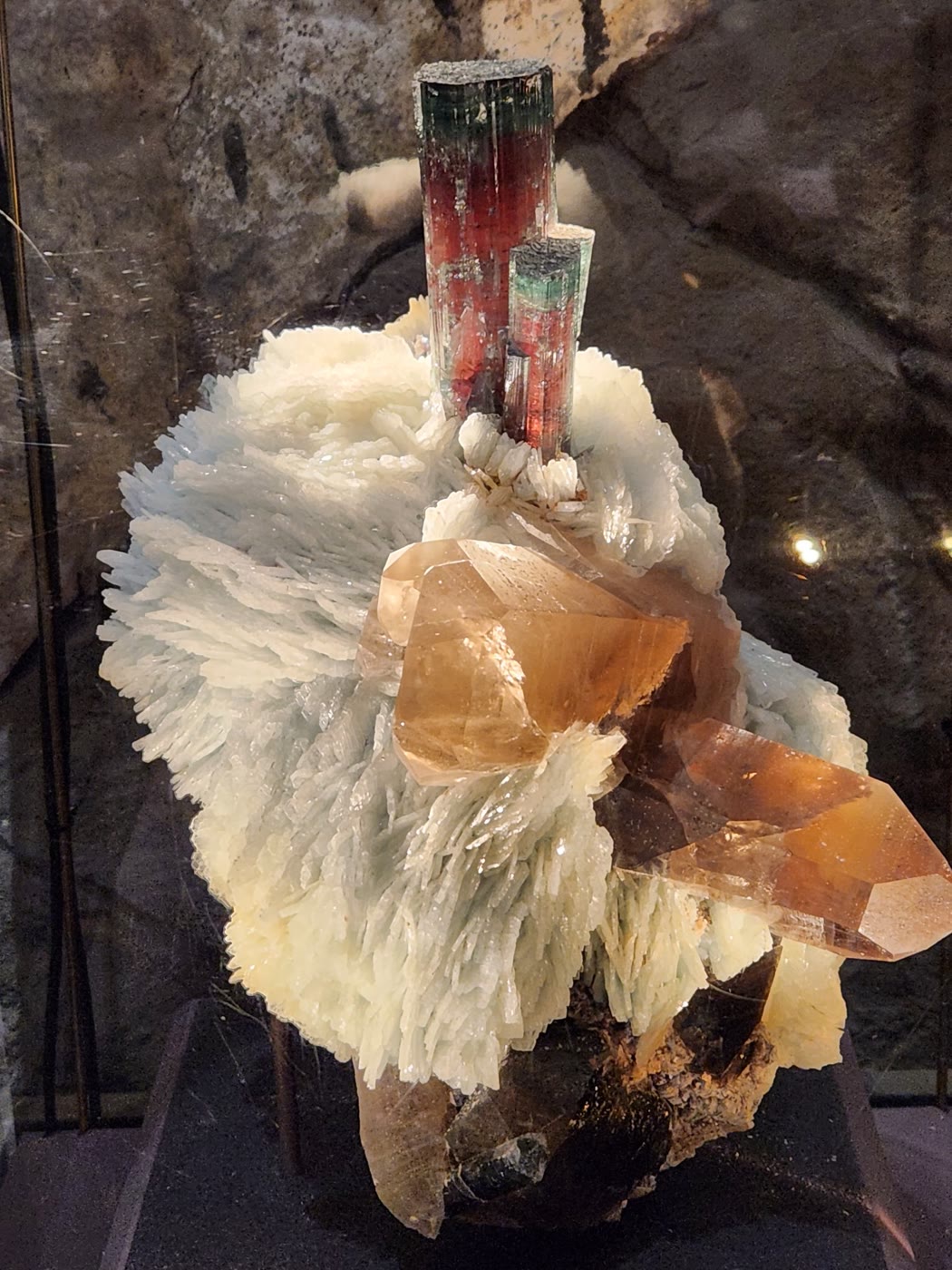
Watermelon tourmaline on cleavelandite
An amazing specimen. Two tall tourmaline crystals stand up out of a frothy white mass of cleavelandite, glowing raspberry red through the body and finishing in bands of deep green at their tops. Large honey-colored crystals lean against the white blades below, adding warm amber to the red, green and white.
Watermelon tourmaline is named for its colors: pink to red inside, green outside, like the fruit. The colors change as the chemistry of the growth fluid changes while the crystal grows, so each band is a record of a different moment. Cleavelandite is a bladed form of albite feldspar, and it is the classic companion of fine tourmaline in gem pegmatites. To find tall, bright, multicolored crystals still standing on their matrix, with nothing broken, is extraordinarily rare.
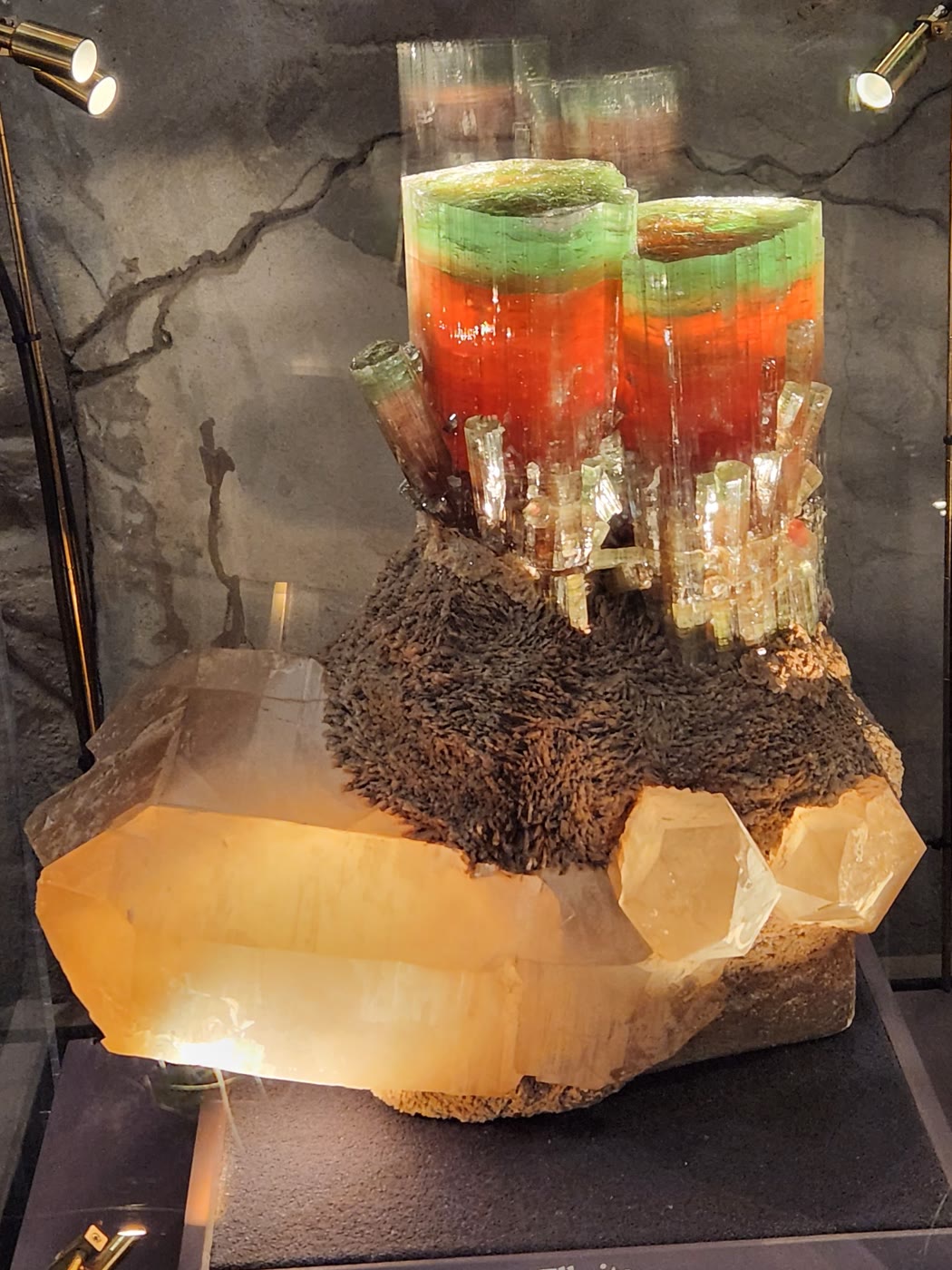
Giant red and green tourmaline with quartz
Two massive tourmaline crystals, thick as a fist, glow fiery red through their bodies under caps of bright mint green. Around their bases cluster dozens of smaller, pale green tourmaline pencils, all rising from a dark, bristling bed of bladed crystals. Below, huge glassy quartz crystals catch the light like lanterns.
Seen from above, each crystal’s green rim wrapped around a red core is the classic watermelon pattern. A specimen like this, with crystals of this size and color still together as they grew in the pocket, is the kind of piece that ends up in museums.
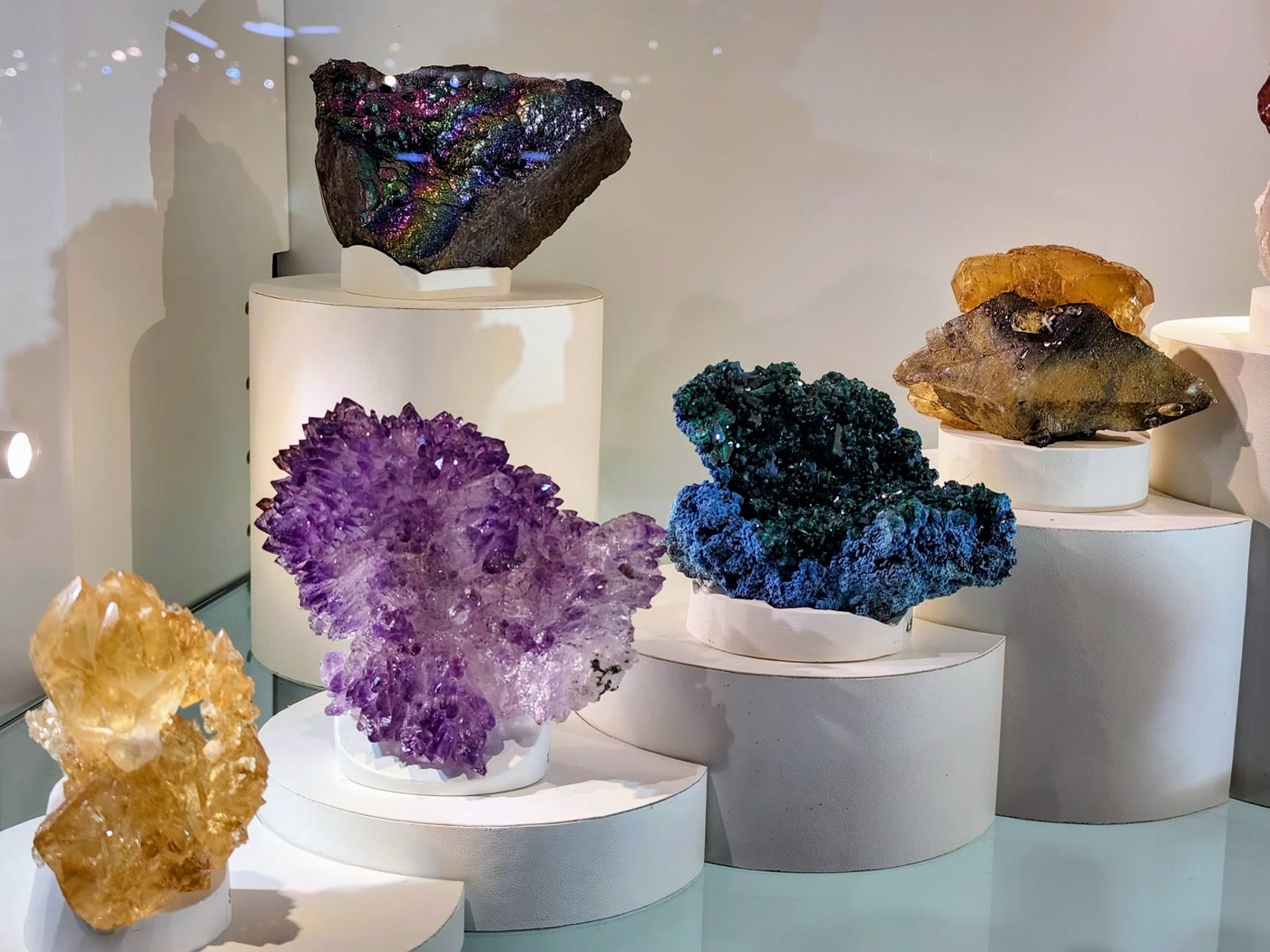
A case full of color
One display case, a whole spectrum. At the top, a dark iron oxide flashes rainbow iridescence in violet, green and gold. The color is not a pigment: it comes from a microscopically thin surface film that splits light, just like oil on water.
In front, an amethyst flower spreads its purple points outward from a pale center. Glowing golden calcite sits at either side, and on the right a deep blue crust is studded with dark green crystals, a colorful pairing typical of copper minerals. Each piece shows a different way nature makes color: trace elements, thin films, and the chemistry of metals like iron and copper.
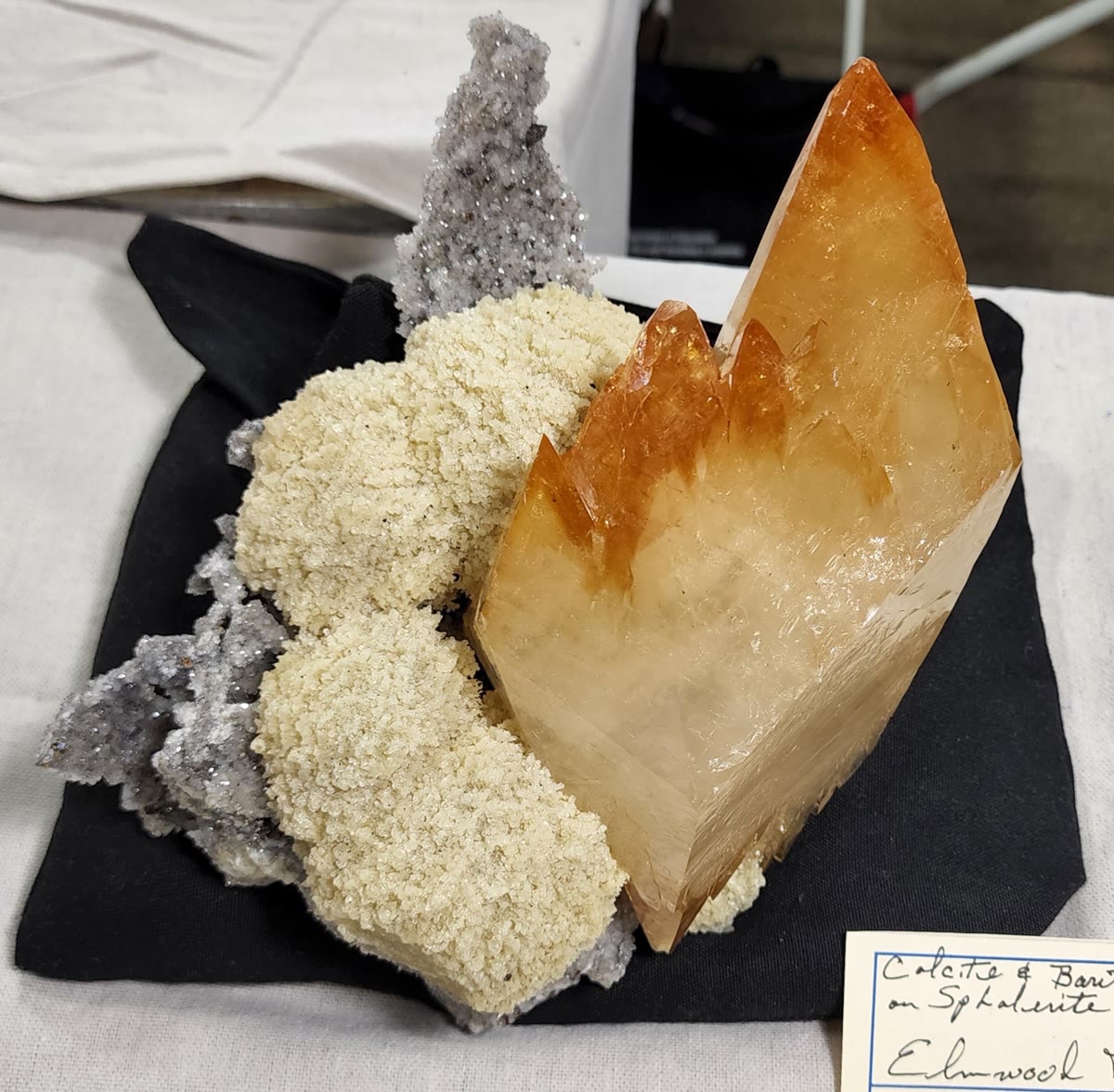
Golden calcite and barite on sphalerite
An outstanding piece. A large, sharply pointed calcite crystal glows honey gold to amber, its tip and edges deepening to rich orange. Beside it sit two rounded masses of creamy barite crystals, all resting on a sparkling gray base over sphalerite, the zinc ore these minerals grew upon.
The Elmwood Mine near Carthage, Tennessee, mined zinc, but collectors know it for something else: some of the finest golden calcite ever found. Its crystals are prized for their size, clarity and warm color, and Elmwood pieces are found in major museum and private collections around the world. This one, with its stepped, flame-like terminations, is a superb example.
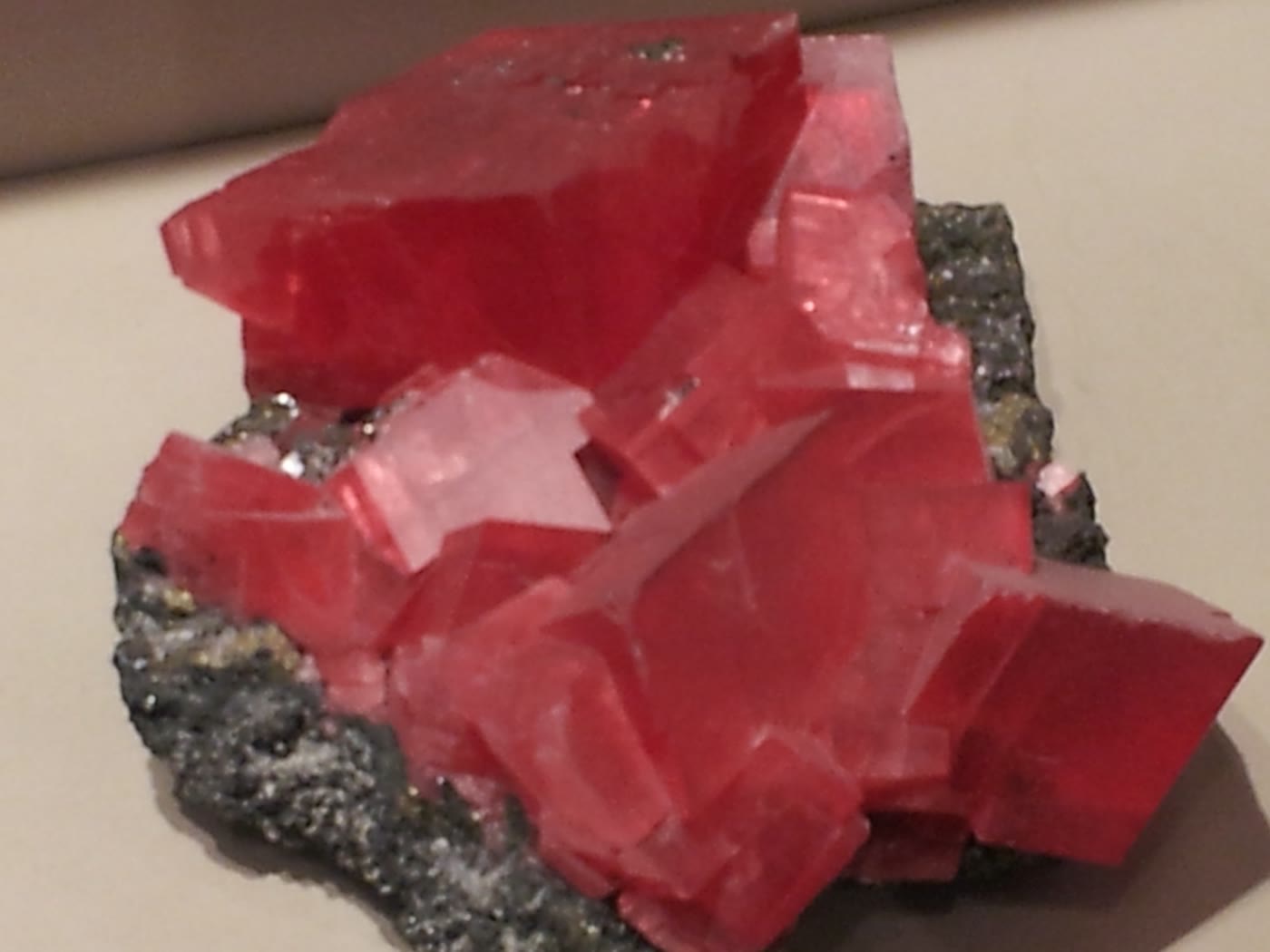
Rhodochrosite rhombs
Here is rhodochrosite in a completely different form. Instead of pointed crystals, these grow as thick, stepped rhombohedrons, like stacked blocks, in a glowing cherry red. They sit on a dark matrix sparkling with metallic minerals.
Large, transparent rhombs like these are among the most sought-after specimens in the mineral world. Put this beside the South African piece above and you can see how one mineral can grow in very different shapes depending on where and how it forms.
Shared by fellow collectors
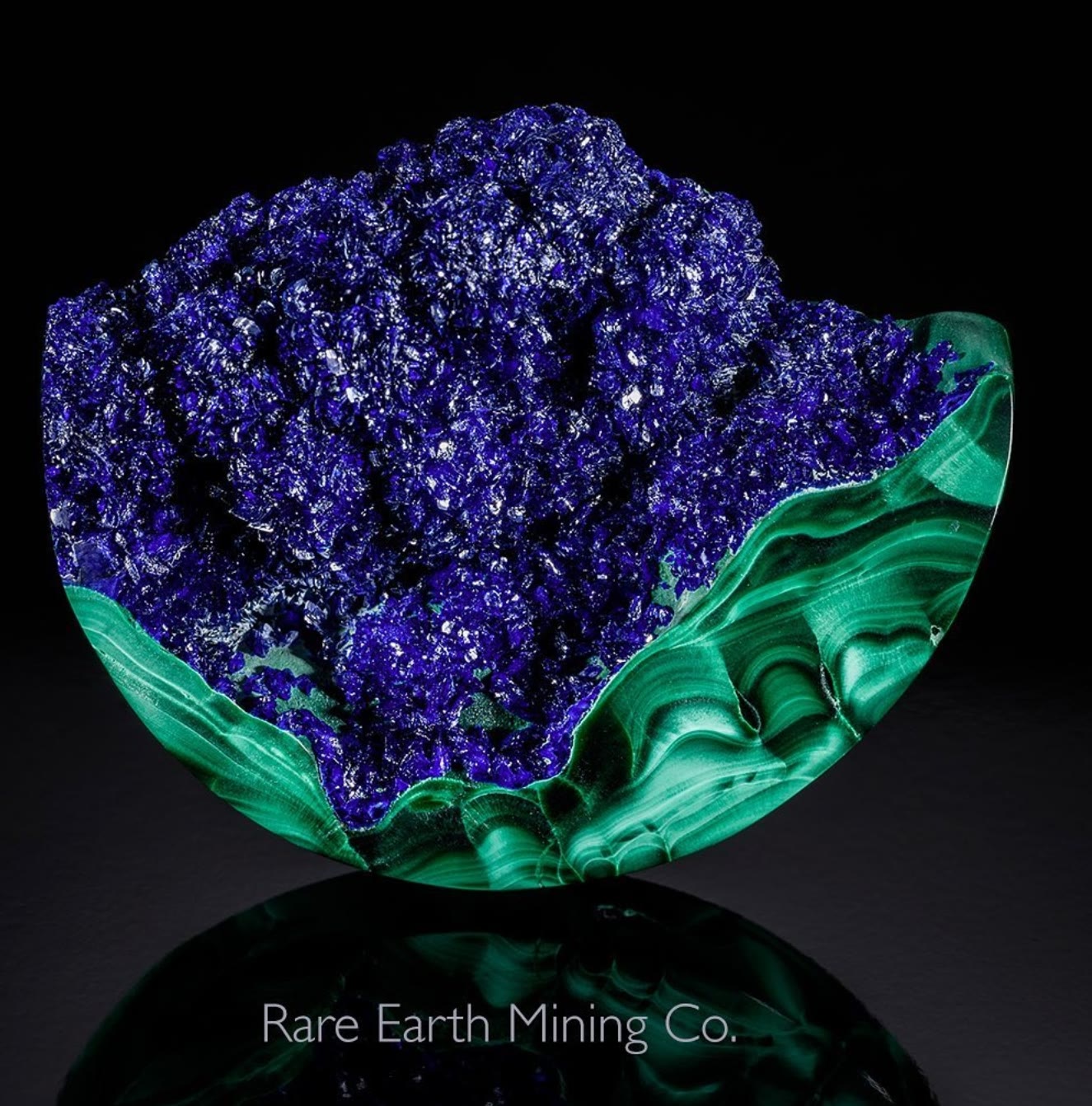
Azurite on malachite
A mass of glittering, deep royal-blue azurite crystals fills a half-moon of polished malachite, whose bands of light and dark green swirl like the grain of exotic wood. The contrast of the two colors is almost unreal.
Azurite and malachite are close cousins, both copper carbonates, and they often grow together in the oxidized upper parts of copper deposits. Over time azurite can slowly turn into malachite as it takes on water, so pieces that keep both, side by side, capture two stages of the same story.
Photograph used with the kind permission of Rare Earth Mining Co.
From my personal collection
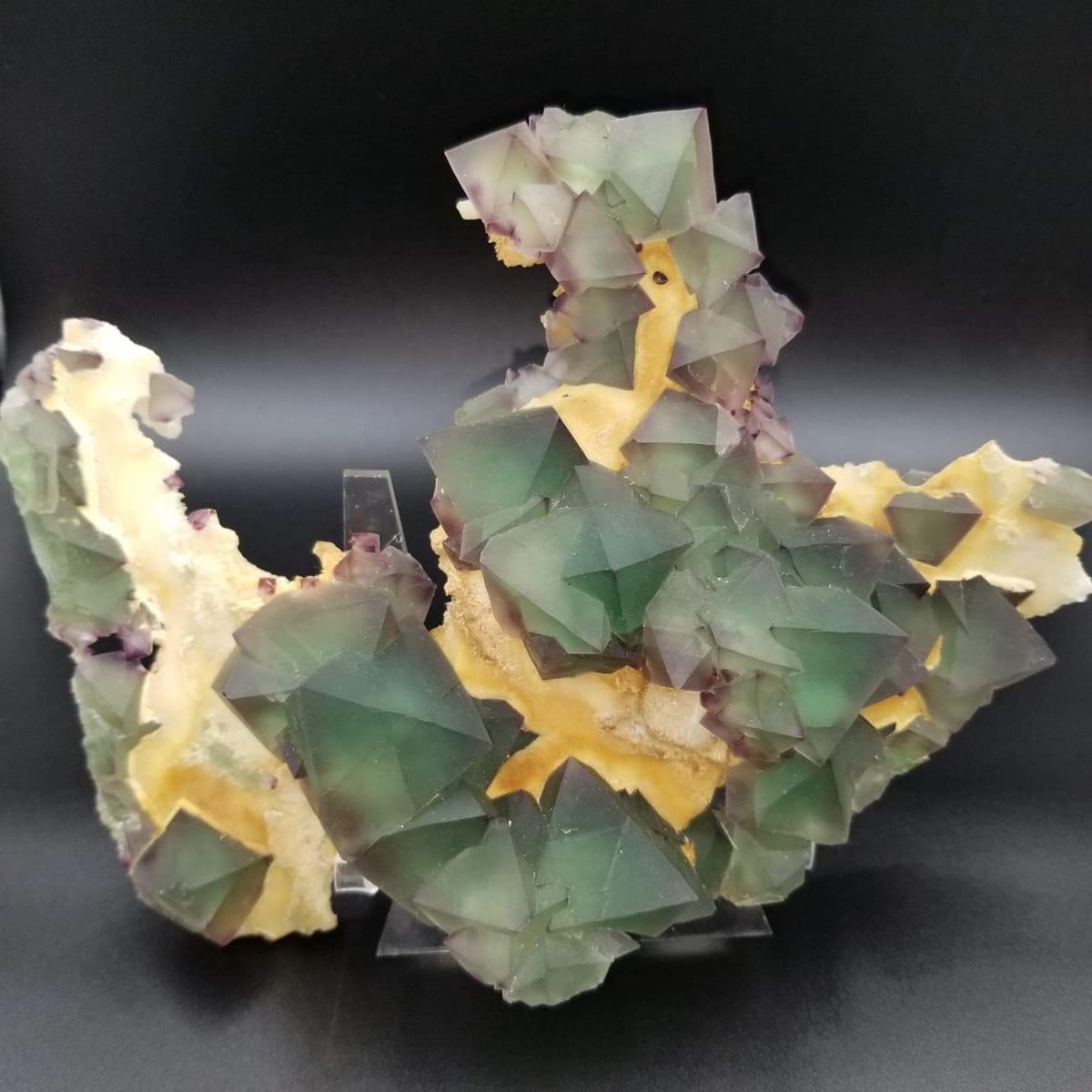
Green and purple fluorite
An outstanding piece from my collection. Dozens of sharp, frosted fluorite octahedrons, each like two pyramids joined at the base, crowd across a creamy, honey-toned matrix. Their cores glow a deep sea green, and their edges and corners are tipped in purple.
That color zoning is a record of the crystals’ growth: as the chemistry of the fluid around them changed, the color of each new layer changed with it. China’s fluorite mines produce some of the most beautiful and varied fluorite in the world, and a large plate with crystals this size and this clean is a true showpiece.
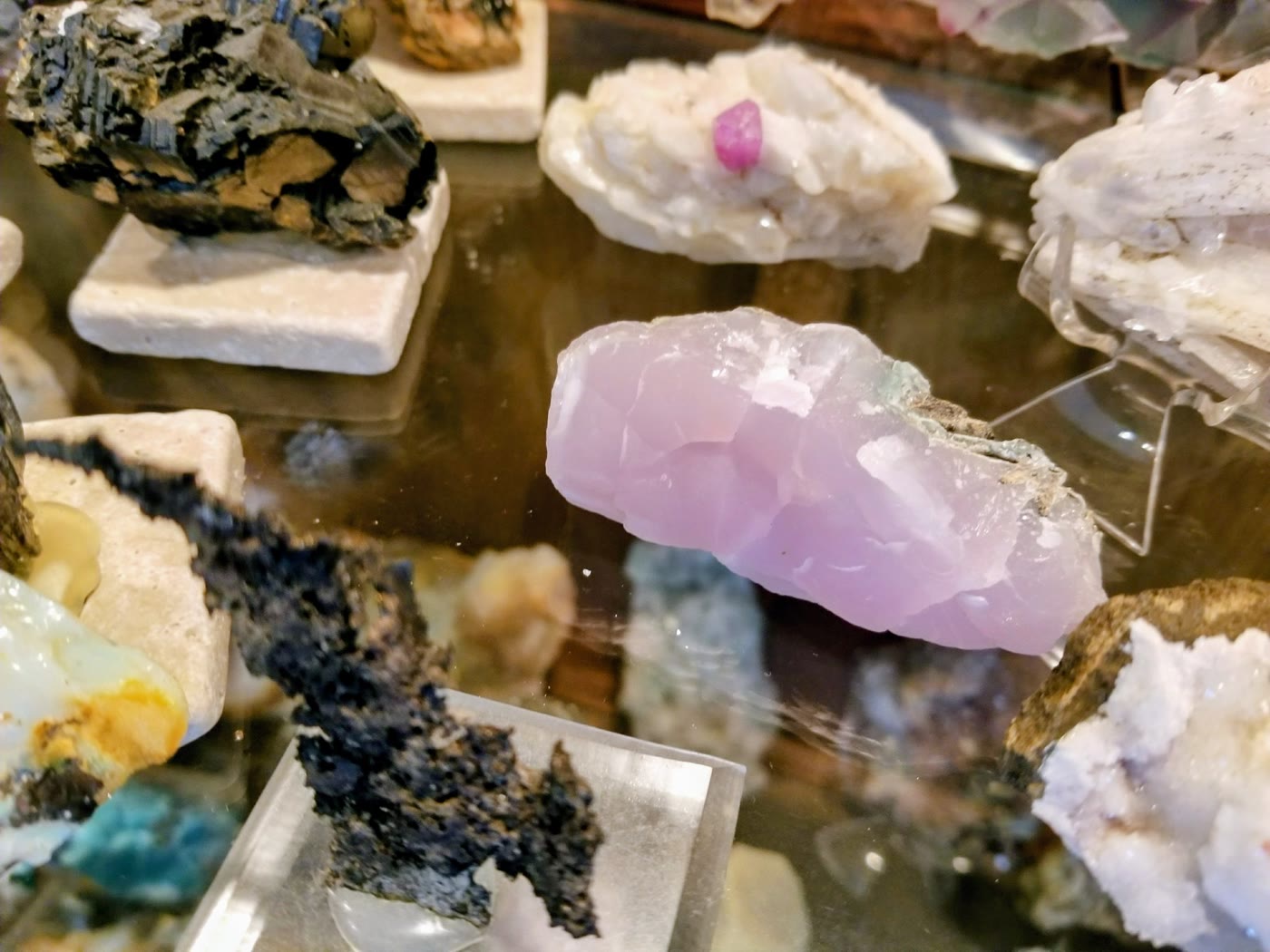
Ruby, smithsonite and native silver
Ruby in marble. Behind the center piece, a small hexagonal ruby crystal still sits in the white marble it grew in. Ruby is corundum colored red by chromium, and many of the finest rubies, including the Burmese stones I work with, form in marble just like this. Seeing a ruby in its host rock is a reminder that every gem in a ring started its life this way.
Smithsonite. The soft lavender mass in the center is smithsonite, a zinc carbonate named for James Smithson, whose bequest founded the Smithsonian Institution. It grows in rounded, bubbly layers with a waxy, almost pearly glow, and comes in lavender, pink, blue-green and yellow depending on trace elements.
Native silver. In front, on the clear stand, is native silver: pure metallic silver that crystallized straight out of the earth in wiry, branching growths. Over time it tarnishes to the dark gray and black you see here, which collectors leave in place as part of its natural character.
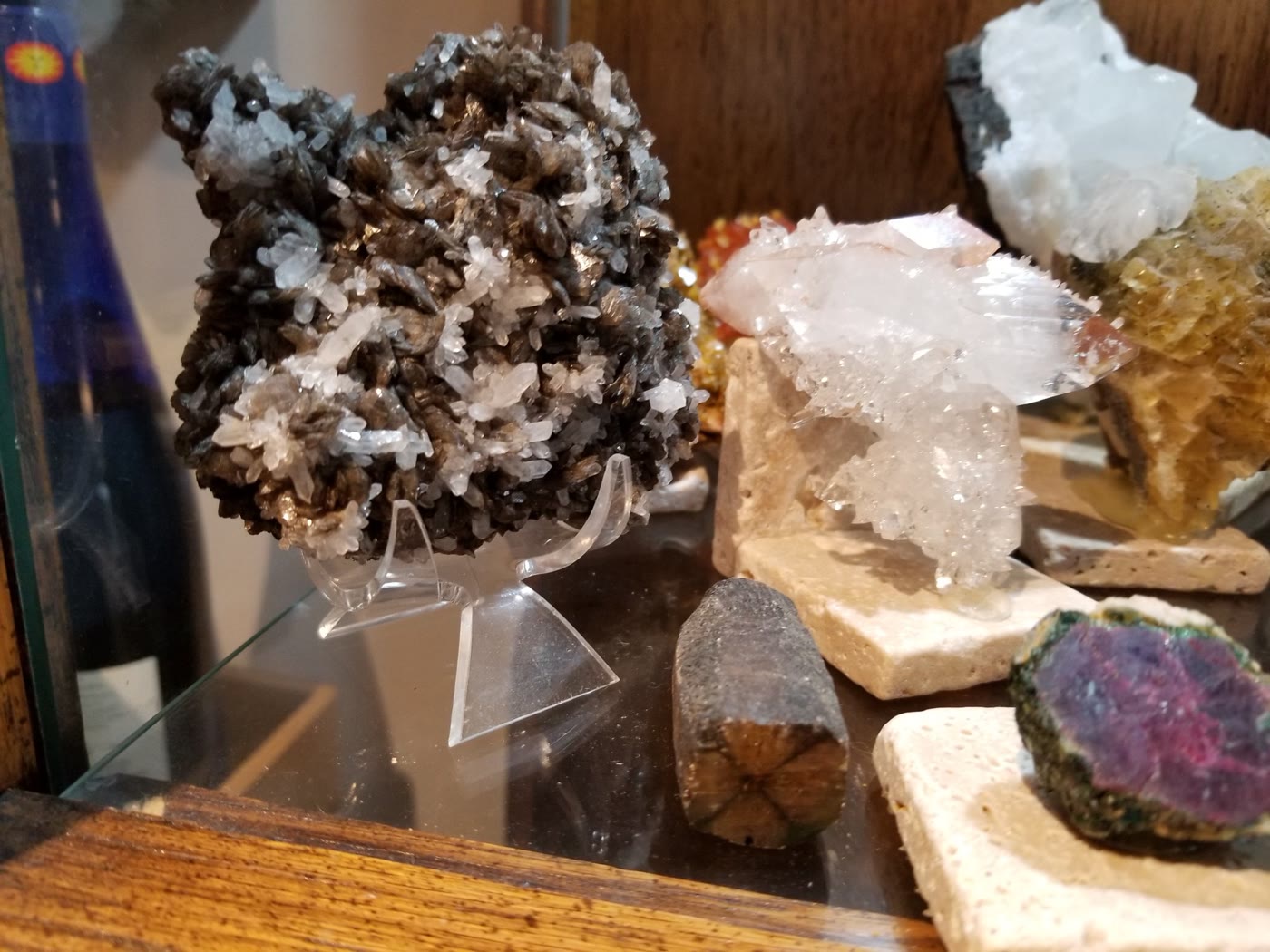
Chiastolite, quartz and tourmaline
Chiastolite. The dark, rough prism in front shows a natural cross on its end. Chiastolite is a variety of andalusite. As the crystal grew, it trapped carbon along its diagonals, leaving this cross pattern running through its whole length. For centuries it was carried as a good-luck charm, and it is still called the “cross stone.”
Quartz and companions. Behind it, a cluster of clear quartz points glitters on its stand. To the left, white quartz crystals sprout from a dark mass of bladed crystals, a lovely contrast of light and shadow.
Tourmaline slice. At the right, a polished slice shows tourmaline’s famous color zoning: a pink-to-purple core inside a green rind. Tourmaline changes color as the chemistry of its growth fluid changes, and a slice like this reads like the rings of a tree.
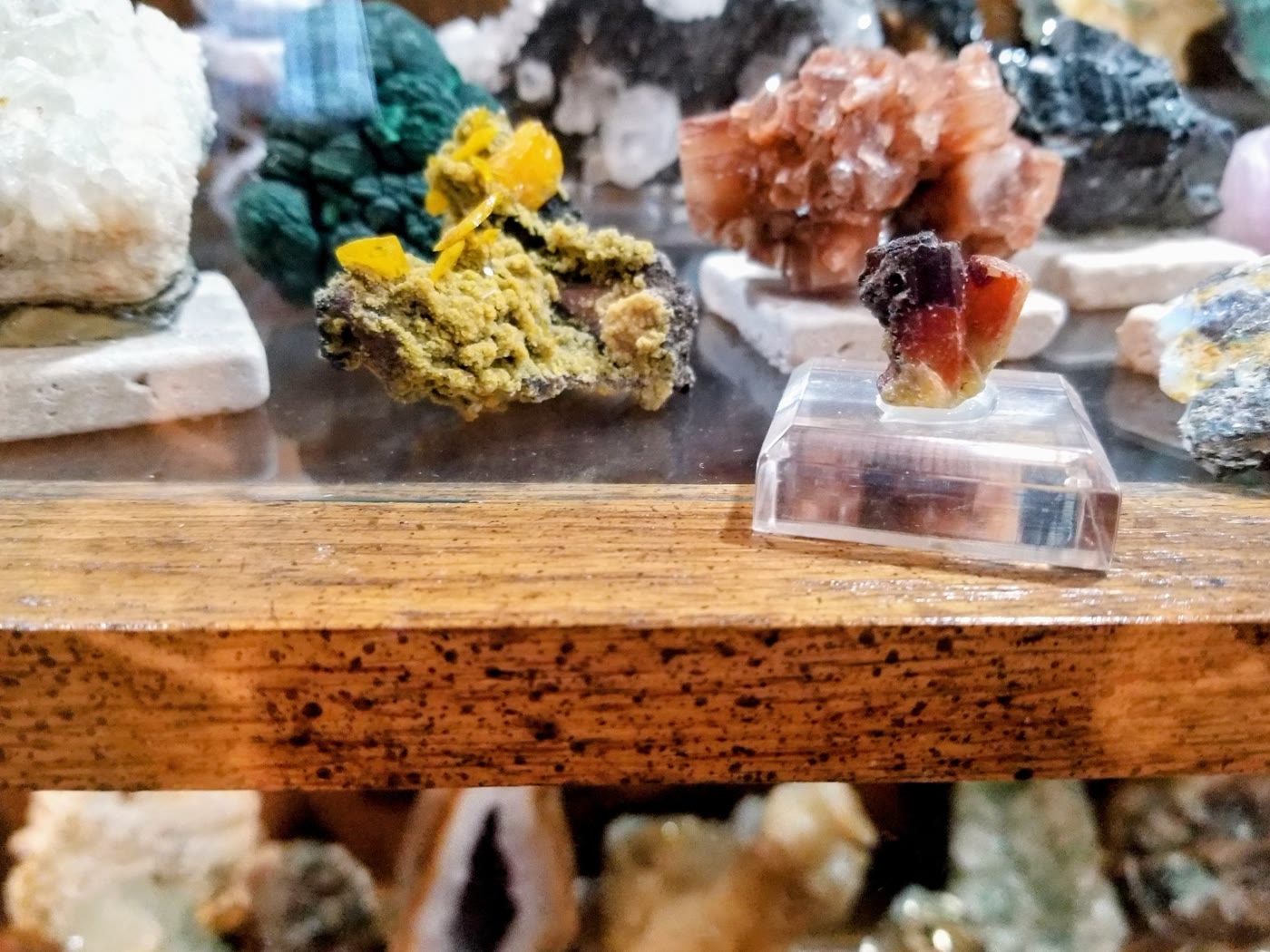
Wulfenite, malachite and aragonite
Wulfenite. The bright orange-yellow plates near the center are wulfenite, a lead molybdate. Its crystals grow as thin, square tablets that glow like stained glass when light passes through them, which makes it one of the most photogenic minerals there is.
Malachite. Behind it is malachite, a copper carbonate that grows in rounded, bubbly clusters of deep green. Cut and polished, it shows bands of light and dark green and has been used for jewelry and decoration for thousands of years.
Aragonite. At the back right, the spiky salmon-orange cluster is aragonite. It shares calcite’s chemistry but crystallizes differently, often in starburst groups like this one. Aragonite is also what pearls and mother-of-pearl are made of.
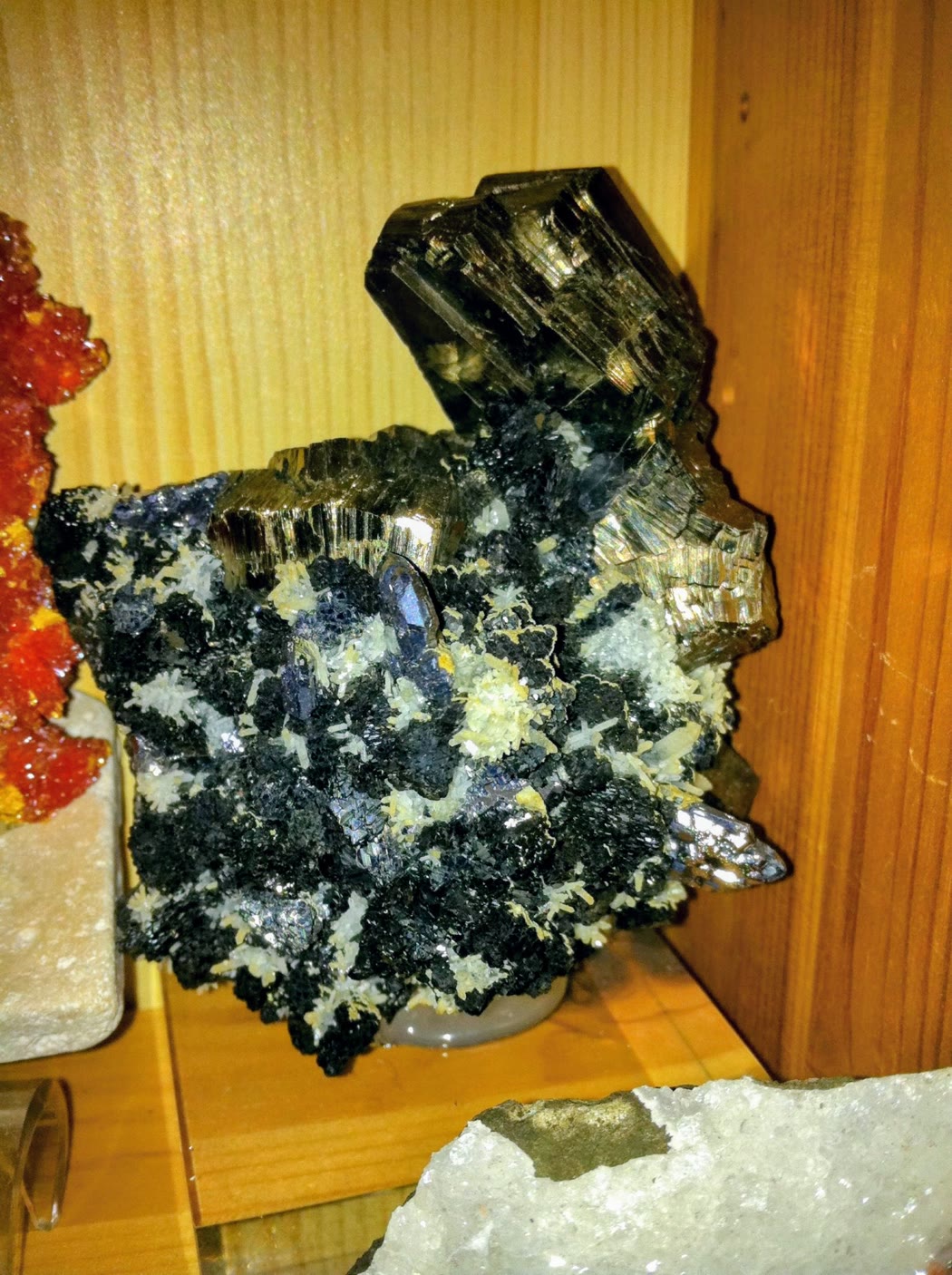
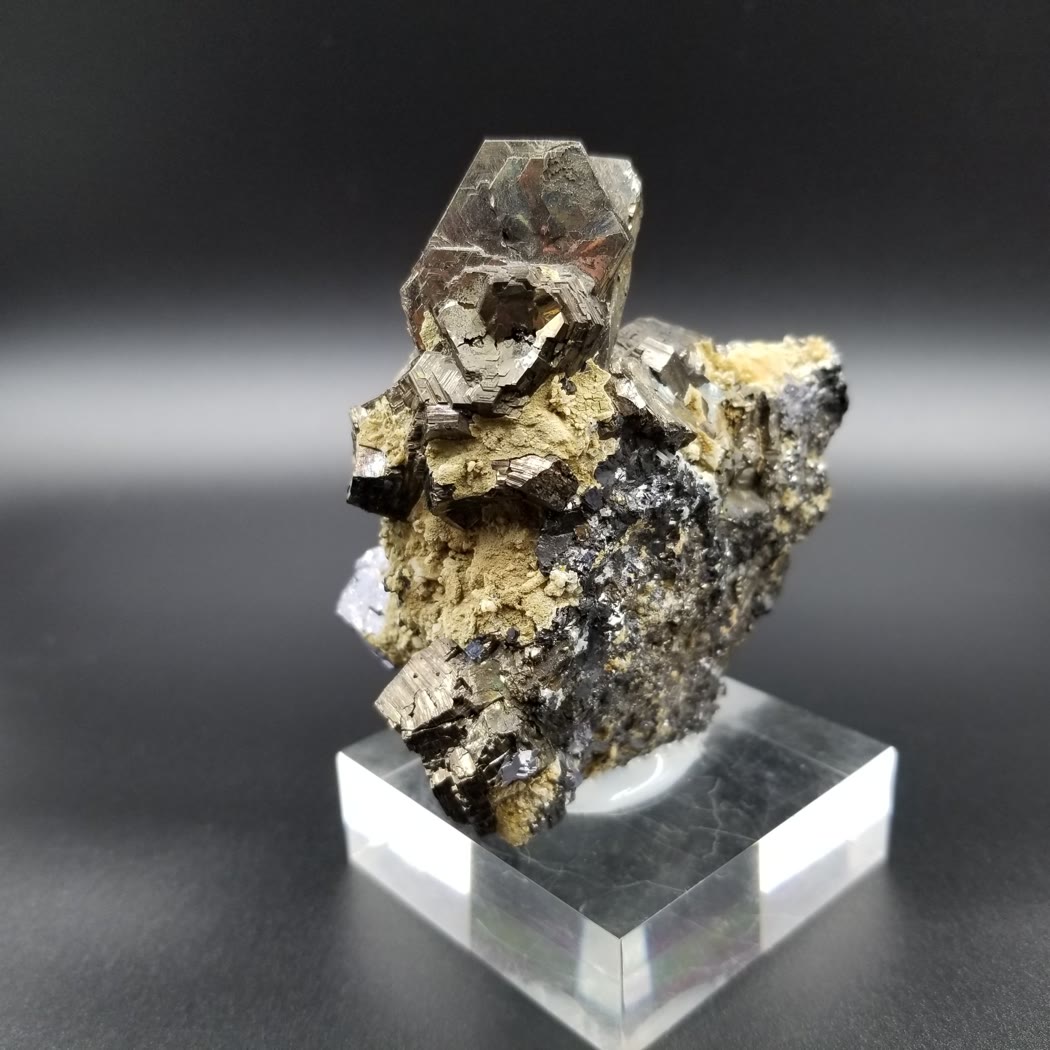
Pyrrhotite, sphalerite and quartz
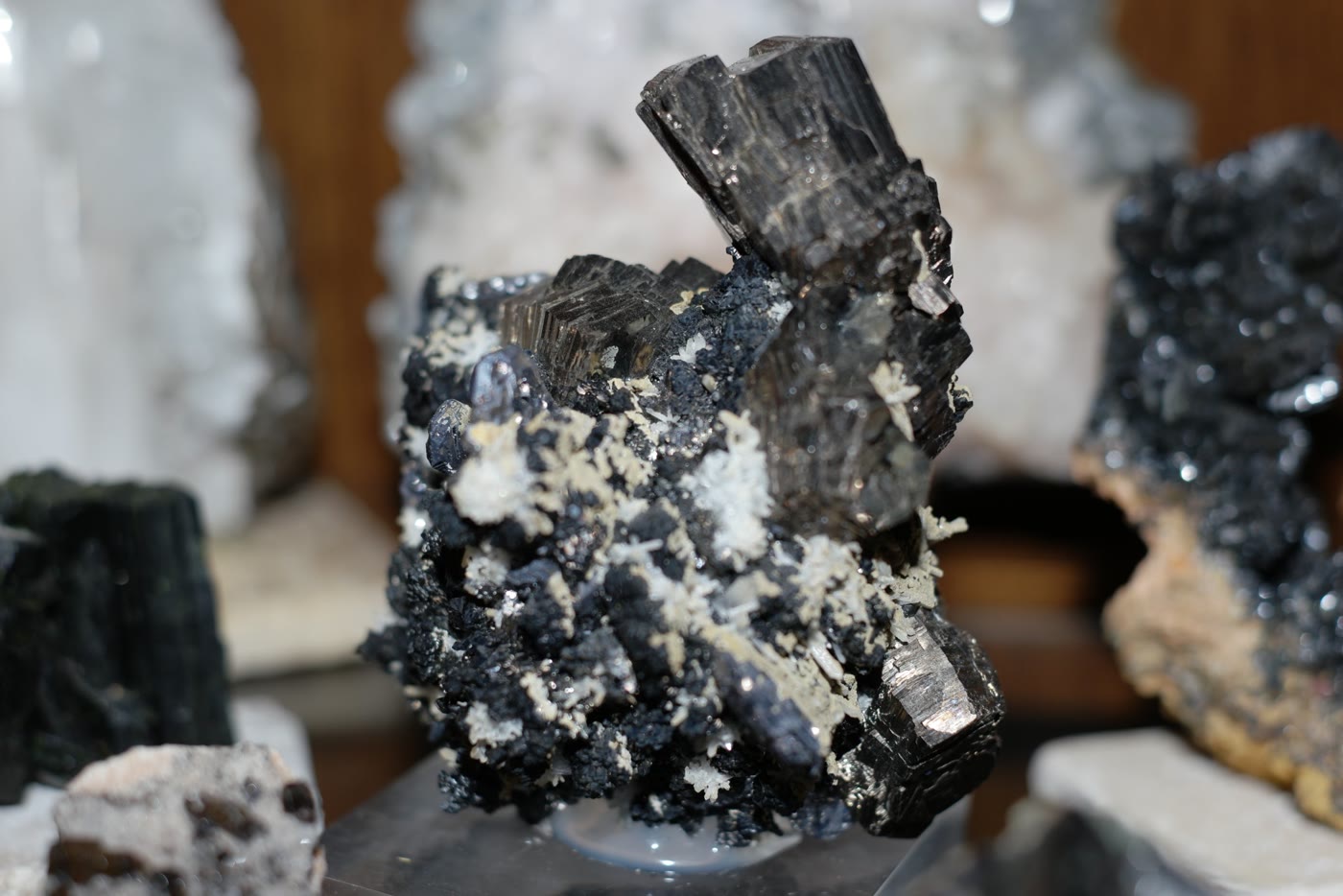
A dramatic combination piece from a metal-ore deposit. Crowning it are stacked, deeply striated plates of bronze pyrrhotite, an iron sulfide that is one of the few naturally magnetic minerals. Its six-sided crystals build up in layers like a stack of coins; the photos from other angles show the hexagonal faces and their stepped edges clearly.
Below, the matrix is thick with lustrous black sphalerite, the main ore of zinc, scattered with sprays of fine white quartz needles and a few bright steel-gray metallic crystals. Pieces like this come from deep hydrothermal veins, where hot, mineral-rich fluids deposited several minerals together. Each one is a snapshot of how the earth makes metal.
Golden fluorite with barite
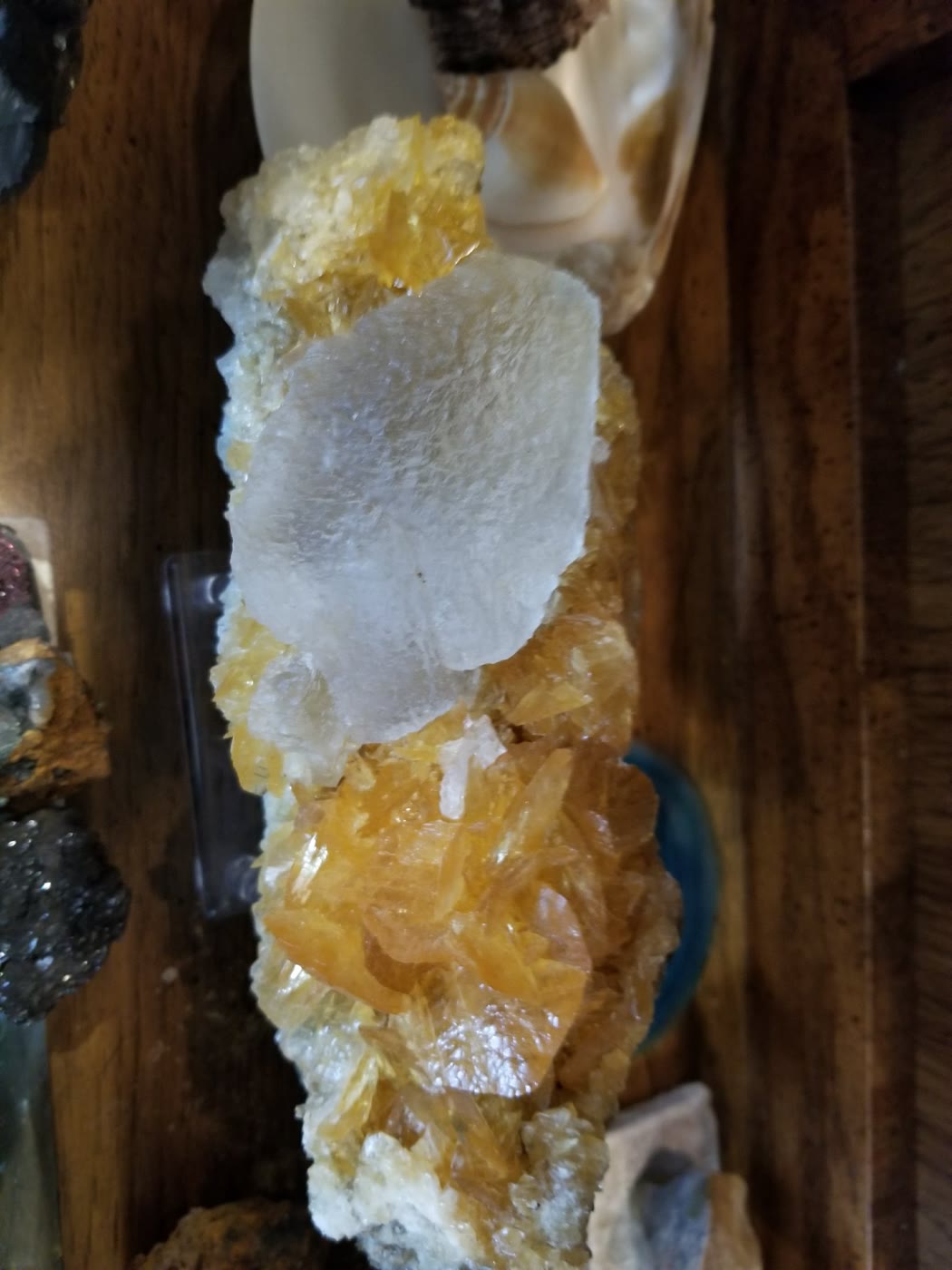
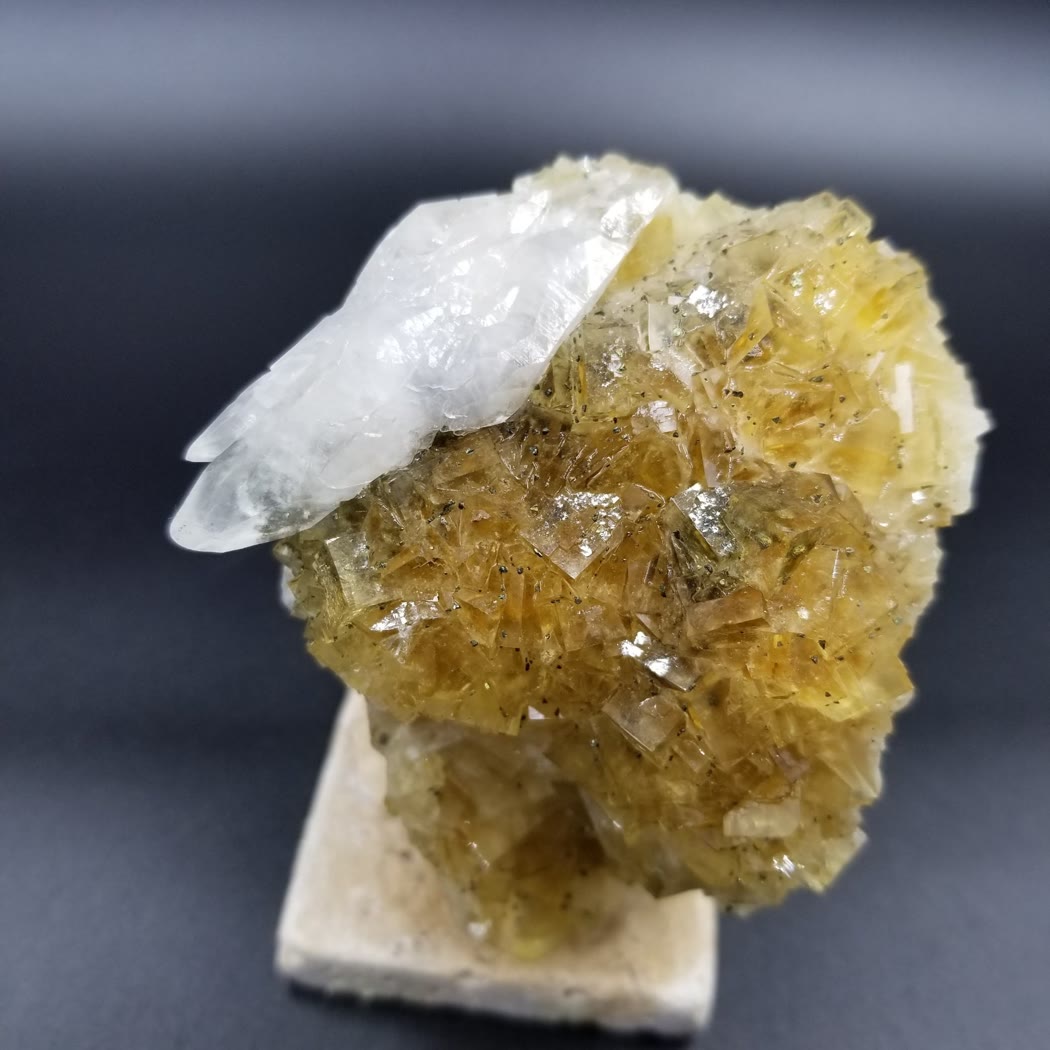
Honey-gold fluorite builds this piece out of hundreds of stacked, stepped cubes. Fluorite is calcium fluoride and comes in nearly every color, and it gave its name to fluorescence, because many fluorite crystals glow under ultraviolet light. Look closely and you will see the cubes dusted with tiny brassy sulfide crystals, sprinkled through the gold like flecks of glitter.
Resting on top is a pale, frosted blade of barite, barium sulfate, a surprisingly heavy mineral for its size. The cool white barite against the warm, glowing fluorite makes a striking contrast. The second photo shows the same piece from another side.

Purple-pink heulandite in a basalt pocket
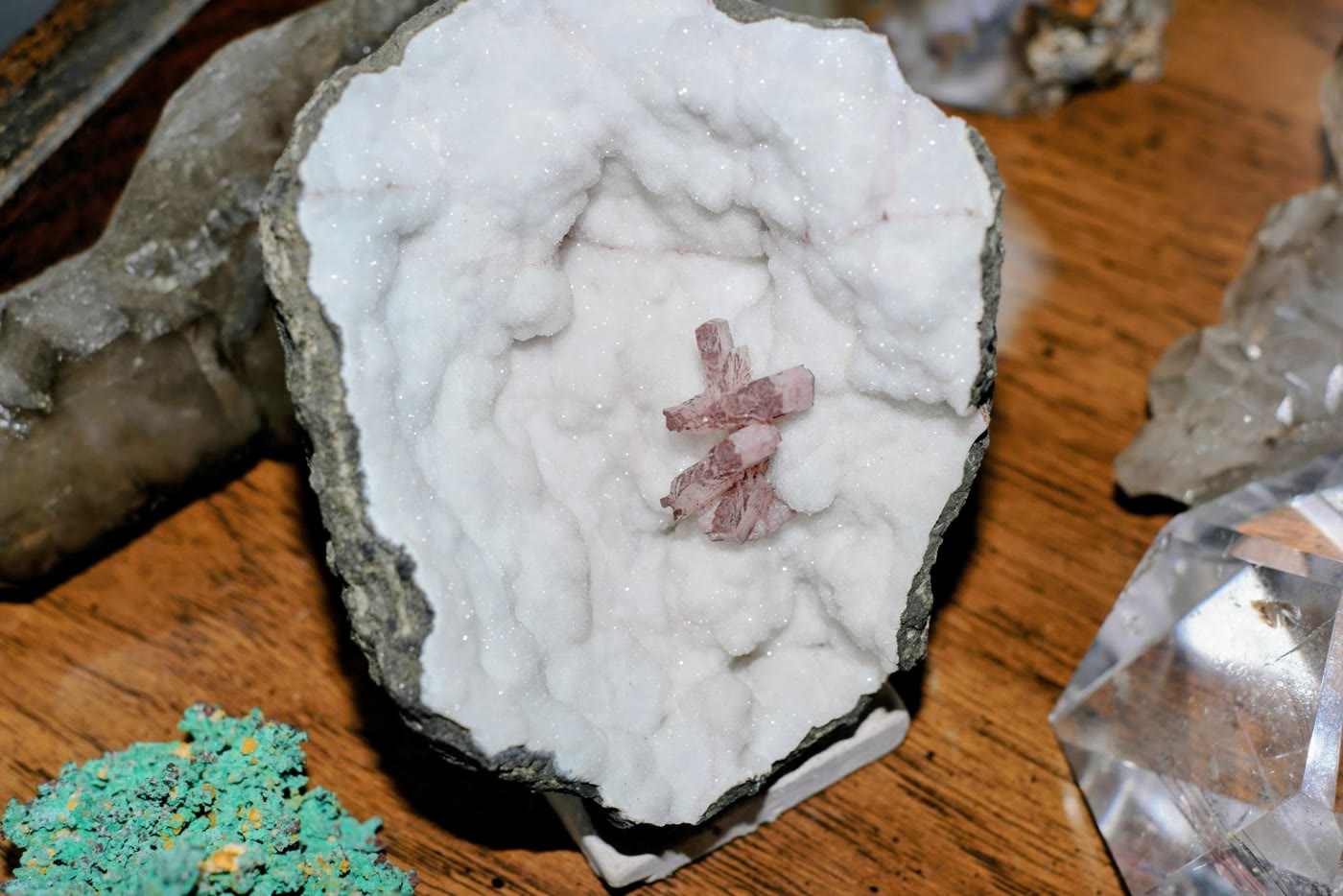
A gas bubble in an ancient lava flow, opened like a book. The dark gray rim is basalt. Inside, the cavity is lined with a sparkling, snow-white crust of tiny crystals, and in the center a small spray of purple-pink crystals stands on its own.
The purple-pink crystals are heulandite, a member of the zeolite family, minerals that grow slowly from mineral-rich water seeping through cooled lava. Their color comes from fine reddish inclusions trapped as they grew. A single, well-placed group like this, set against a clean white background, is exactly what collectors look for.
Sapphire crystal in its host rock
Before a sapphire is cut, this is what it looks like. This rough blue sapphire crystal still has its natural barrel shape, with tapering six-sided faces rising to a point. Part of it is still wrapped in the light and dark rock it grew in.
Sapphire is corundum, aluminum oxide, the same mineral as ruby, and the second-hardest natural gemstone after diamond. Traces of iron and titanium give it its blue. Watch the video as it turns: the crystal faces are the stone’s original surfaces, untouched by any cutter. Every faceted sapphire in a ring began as a crystal like this one.
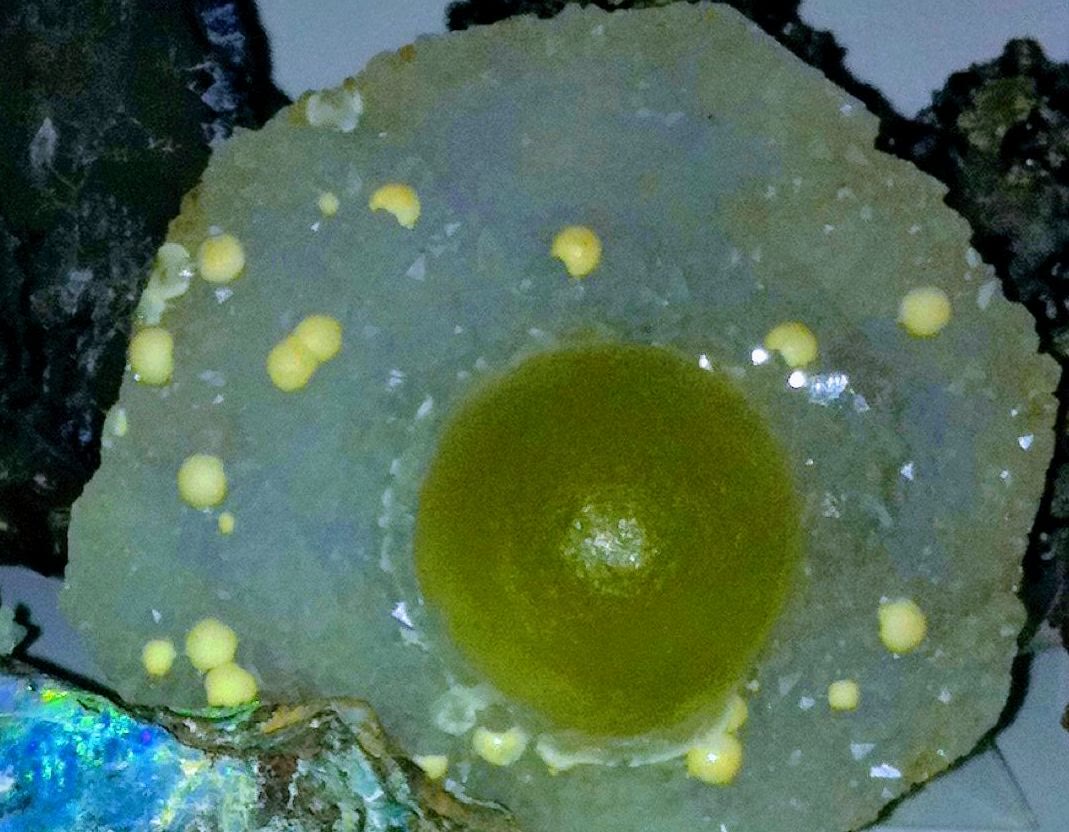
Wavellite
At the center of this pale, sparkling plate sits a perfect green disc, and scattered around it are small, bright yellow spheres. Look closely at the disc and you will see it is built from fine needle crystals radiating out from a single point, like the spokes of a wheel.
That radiating habit is the signature of wavellite, an aluminum phosphate. When a wavellite rosette is broken across, it reveals these circular “pinwheels” or starbursts, and the small spheres are the same mineral just beginning to grow. It is a lovely example of how simple geometry can arise all on its own in nature.
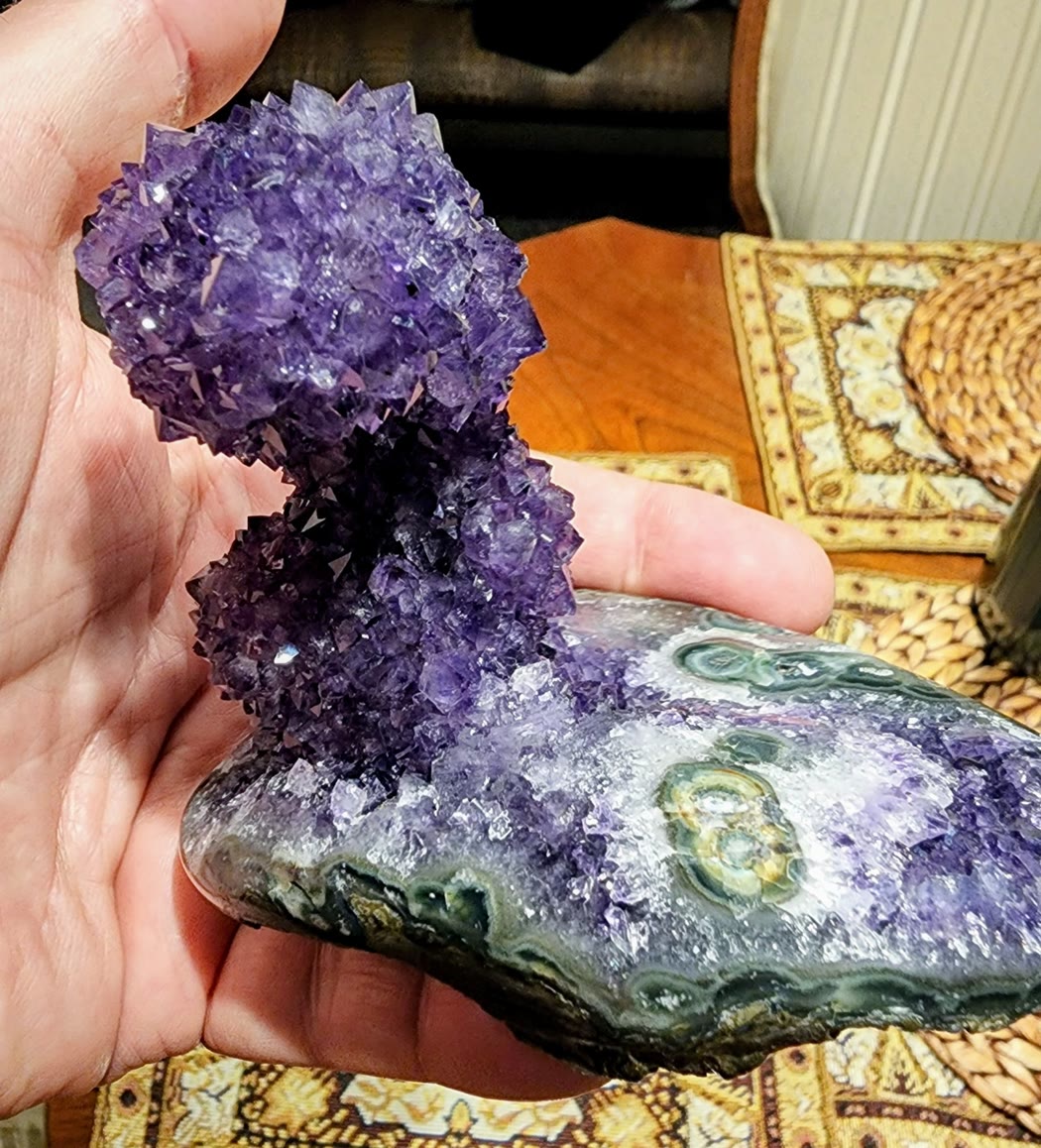
Amethyst stalactite
Two balls of sparkling, deep purple amethyst crystals, one stacked on the other, rise from a polished base. Each ball formed around a stalactite: a thin finger of chalcedony that hung inside a cavity in ancient lava, which amethyst then coated on every side, so the crystals point outward in all directions like a flower in bloom.
The polished base tells the rest of the story. Its round green and gold “eyes” are stalactites cut straight across, showing the rings of agate at their cores with amethyst around them. Formations like this are typical of the amethyst deposits of southern Brazil and Uruguay, and it is rare to find one standing upright and intact.
Browse loose gemstones Book a consultation
The specimens on this page are shown for viewing pleasure only and are not for sale. Show, gallery and shared specimens belong to their owners.